
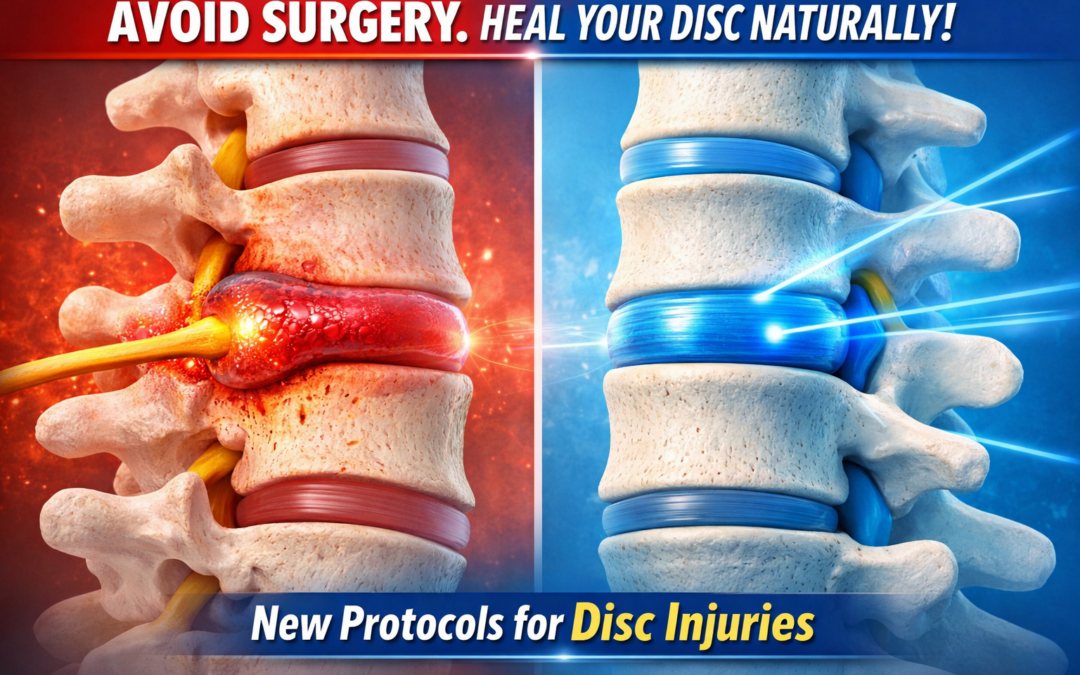
Why Advanced Decompression + Laser Protocols Are Changing the Way We Treat Disc Injuries
Back pain, disc herniations, and nerve-related symptoms like numbness or sciatica are often treated the same way everywhere: manage the symptoms, reduce pain, and if that fails—consider surgery.
But that model misses the most important question:
Why did the problem happen in the first place?
The Problem with Traditional Approaches
Most conventional treatments focus on what hurts and where it hurts, but not why it happened.
-
Pain medications reduce symptoms—but don’t fix the cause
-
Injections may calm inflammation—but don’t restore function
-
Physical therapy helps movement—but may miss deeper mechanical issues
-
Surgery removes or alters tissue—but doesn’t correct underlying dysfunction
That’s why many patients experience recurring pain, incomplete recovery, or new issues later on.
A Different Philosophy: Find and Fix the “Why”
Disc herniations don’t happen randomly. They are typically the result of underlying mechanical problems such as:
-
Core instability
-
Chronic compression from poor posture
-
Repetitive stress or movement dysfunction
-
Long-standing inflammation
If you don’t address these root causes, the problem is likely to persist—or return.
That’s where our approach is different.
Why Our Decompression + Laser Protocol Is More Effective
Our system combines two powerful therapies that work together, not separately:
1. Spinal Decompression (Mechanical Correction)
Decompression therapy creates a targeted vacuum effect inside the disc, which:
-
Reduces pressure on nerves
-
Helps draw herniated material back into place
-
Improves disc hydration and nutrient flow
This is not just “stretching”—it’s a precise, controlled process designed to restore disc mechanics.
2. Laser Therapy (Biological Healing)
While decompression addresses the structure, laser therapy enhances the healing environment by:
-
Reducing inflammation at the cellular level
-
Increasing circulation and tissue repair
-
Accelerating recovery time
Why the Combination Matters
Used together, these therapies create a synergistic effect:
-
Decompression relieves pressure
-
Laser reduces inflammation
-
The body is finally able to heal efficiently
This is why patients often experience faster and more complete results compared to using either therapy alone.
Real-World Outcomes
Patients who once struggled with:
-
Leg numbness
-
Severe back pain
-
Limited mobility
Often return to:
-
Normal daily activities
-
Exercise and recreation
-
Pain-free movement
When the cause is corrected, not just the symptoms, the results are more lasting.
Why Avoid Surgery When Possible
Surgery can be necessary in certain cases—but it should rarely be the first option.
Here’s why:
1. Surgery Doesn’t Address the Root Cause
Removing or trimming a disc doesn’t fix instability, posture, or movement dysfunction.
2. Risk of Recurrence or Adjacent Problems
Many patients experience:
-
Re-herniation
-
Degeneration at nearby levels
-
Continued or new pain
3. Higher Risk and Recovery Time
Surgery involves:
-
Downtime
-
Potential complications
-
Permanent structural changes
A Smarter, More Complete Approach
Our protocol focuses on three critical goals:
 Relieve pressure Reduce inflammation Correct the underlying cause
This combination is what leads to:
-
Faster relief
-
Better long-term outcomes
-
Reduced need for invasive procedures
The Bottom Line
It’s not enough to ask:
-
Where is the pain?
-
What does the MRI show?
You have to ask:
Why did this happen?
Because when you find—and fix—the “why,”
You don’t just manage pain…
You restore function and give patients their lives back.
Recent Comments